


Building a Phishing Response Playbook: From Detection to Recovery
-
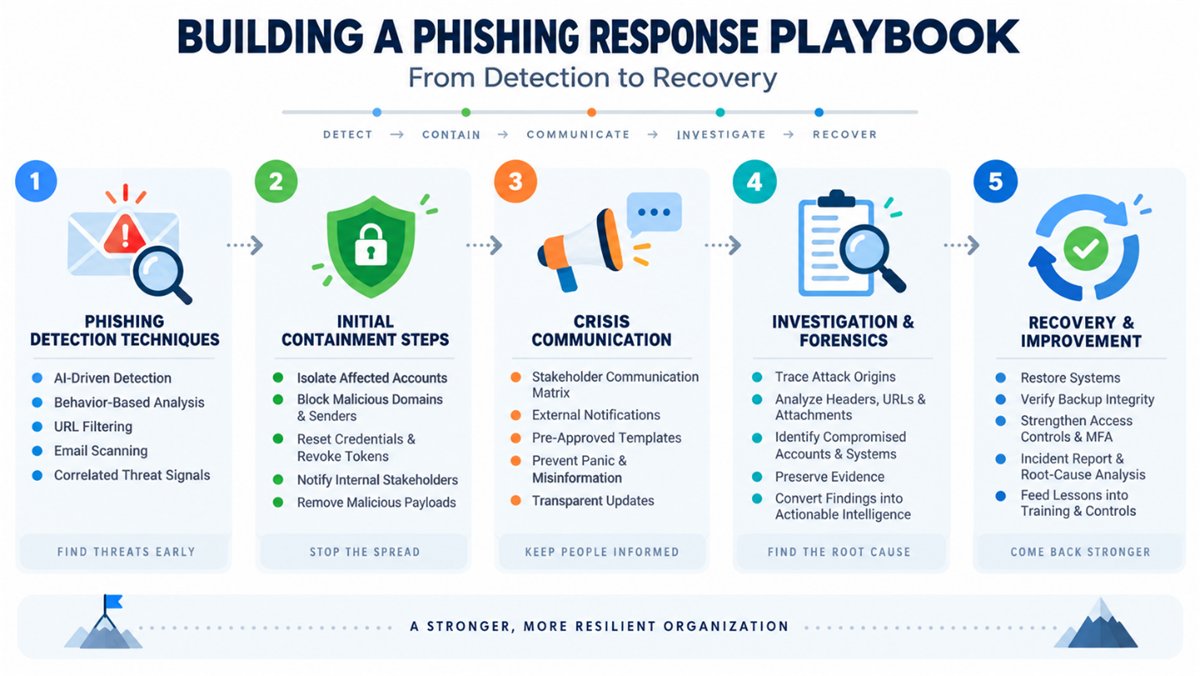
A phishing response playbook should not be treated as optional. It is a practical framework that defines how an organization detects, contains, investigates, and recovers from a phishing incident.
-
-
*
Unlike a static policy document, a playbook should evolve as threats, technologies, and business processes change.
A well-designed phishing response plan helps organizations:
- standardize how suspicious activity is identified and escalated;
- reduce response time when an incident occurs;
- contain threats before they spread across users, devices, and systems;
- improve cyber resilience and recovery;
- incorporate new threat intelligence and lessons learned from previous incidents.
The main value of a playbook is speed, consistency, and accountability. Everyone involved should understand their responsibilities and know what actions to take as soon as a phishing incident is detected.
A response playbook can also support compliance with data protection and cybersecurity requirements such as the General Data Protection Regulation (GDPR), Health Insurance Portability and Accountability Act (HIPAA), National Institute of Standards and Technology (NIST) frameworks, and International Organization for Standardization / International Electrotechnical Commission (ISO/IEC) 27001 and 27002.
Modern phishing defense requires more than detection alone. Preventive measures such as email authentication, brand-verification technologies, employee awareness, and technical filtering can reduce risk, while the response playbook defines what happens when an attack still gets through.
-
*
Phishing Detection Techniques
Detection is the first stage of any phishing response playbook. An organization cannot respond effectively to an incident it does not recognize.
Because phishing now appears not only in email but also in messaging, collaboration, and social platforms, detection should cover the wider communication environment.
AI-Driven Phishing Detection
Artificial Intelligence (AI)-assisted detection systems can analyze phishing indicators that go beyond traditional signatures.
These systems may evaluate message tone, grammar, sender behavior, header anomalies, domain reputation, and other patterns that can indicate deception.
This is especially valuable as attackers increasingly use Artificial Intelligence to create more polished and context-aware messages.
Behavior-Based Analysis
Behavioral analysis focuses on unusual activity compared with normal user patterns.
Security systems can monitor authentication events, device behavior, locations, and user activity to identify anomalies.
For example, the same account signing in from two geographically distant locations within a short period can indicate compromised credentials.
URL Filtering and Reputation Analysis
Malicious and newly registered domains remain common components of phishing campaigns.
URL filtering systems analyze links for factors such as:
- domain reputation;
- domain age;
- appearance in threat-intelligence feeds;
- suspicious redirects;
- shortened URLs;
- known malicious infrastructure.
These checks help prevent users from reaching credential-harvesting pages or malicious websites.
Email Scanning and Content Inspection
Email scanning examines headers, attachments, links, Hypertext Markup Language (HTML), and embedded content for signs of malicious activity.
Heuristic analysis and sandboxing can be used to inspect suspicious attachments or scripts in an isolated environment before they reach users.
When a message is identified as malicious, it can be quarantined automatically.
AI and Behavioral Analytics for Early Detection
The strongest detection strategies combine Artificial Intelligence with behavioral telemetry.
By correlating signals across inboxes, endpoints, identities, and networks, security systems can identify patterns that may not appear suspicious in isolation.
For example, a sudden increase in failed logins combined with internal messages containing suspicious domains may indicate an active phishing campaign.
-
*
Initial Containment Steps for a Phishing Incident
Once an incident is detected, containment should begin immediately.
The objective is to stop the attack from spreading across users, devices, accounts, and systems.
Isolate Affected Accounts and Devices
Compromised user accounts, mailboxes, and endpoints should be isolated or quarantined as quickly as possible.
This can prevent attackers from accessing additional data, moving laterally, or continuing to communicate from compromised accounts.
Block Malicious Domains, Senders, and IP Addresses
Block known malicious sender addresses, domains, URLs, and Internet Protocol (IP) addresses associated with the phishing campaign.
This helps cut off communication between the attacker and affected users or systems.
Initiate Access Management Changes
If credentials may have been compromised, reset affected passwords immediately.
Revoke active access tokens and terminate suspicious sessions.
If the organization uses Single Sign-On (SSO), compromised sessions should also be invalidated.
Notify Internal Stakeholders
Relevant internal teams should be informed as soon as the incident is confirmed.
The playbook should clearly identify who needs to be contacted and what each team is responsible for.
Depending on the organization, stakeholders may include:
- Security Operations Center (SOC);
- Information Technology (IT);
- Human Resources (HR);
- Legal;
- Compliance;
- Public Relations (PR);
- Executive Leadership.
Remove the Threat
Organizations should determine whether the phishing campaign delivered malware or another malicious payload.
Affected endpoints and systems should be scanned, and malicious files, scripts, or other artifacts should be removed.
Review Security Policies and Procedures
A successful phishing incident often reveals a gap in existing controls.
Security teams should identify what allowed the attack to succeed and update access policies, technical controls, procedures, or employee guidance where necessary.
-
*
Crisis Communication Strategy After a Phishing Attack
Communication is an important part of incident response.
Without a clear communication process, conflicting messages can create confusion, delay response, and damage trust.
The playbook should define how information is shared with both internal and external stakeholders.
Create a Communication Matrix
The organization should identify everyone involved in incident communication and assign clear responsibilities.
Typical stakeholders include the Security Operations Center, Information Technology, Human Resources, Legal, Public Relations, Compliance, and executive leadership.
The communication matrix should define:
- who receives updates;
- who prepares messages;
- who approves them;
- how frequently updates are issued;
- which communication channels are used.
Communicate Clearly with External Stakeholders
Depending on the incident, external communication may involve regulators, customers, partners, insurers, analysts, or law enforcement.
Messages should be accurate, timely, and based on confirmed information.
Where appropriate, communication may explain what happened, what systems were affected, and what mitigation steps have been taken.
Use Pre-Approved Templates
Incident communication should not be created from scratch during a crisis.
The playbook should include templates for:
- internal alerts;
- executive briefings;
- customer notifications;
- regulatory communication;
- public statements.
Templates should be concise and understandable to non-technical audiences.
Prevent Panic and Misinformation
Major incidents can generate conflicting information quickly.
Organizations should establish a single source of verified information and, where appropriate, designate an authorized spokesperson.
This reduces the risk of employees, customers, or partners receiving inconsistent messages.
Balance Transparency and Investigation
Organizations should provide enough information to maintain trust and meet legal or regulatory obligations.
At the same time, sensitive details that could compromise an investigation or expose additional security information should be protected.
-
*
Phishing Incident Investigation and Forensic Steps
After containment begins, the security team must determine how the attack happened, what systems were affected, and what information may have been exposed.
Investigation procedures should be defined in the phishing response playbook in advance.
Trace the Attack Origin and Timeline
Start with the moment the incident was detected and work backward.
Security teams should reconstruct the attack timeline using available evidence such as:
- mail-flow logs;
- authentication logs;
- threat-intelligence data;
- endpoint telemetry;
- user activity;
- security alerts.
The objective is to understand how the attack entered the environment and how it progressed.
Analyze Email Headers, Attachments, and URLs
Email headers can reveal useful information about the source and routing of a suspicious message.
Security teams should examine:
- sender information;
- reply-to addresses;
- authentication results;
- domains;
- embedded URLs;
- attachments.
Suspicious files and links should be analyzed in isolated environments where possible.
Identify Compromised Systems, Accounts, and Data
The investigation should determine the full scope of the incident.
Security teams should review network activity, authentication records, cloud logs, endpoint data, and other available telemetry to identify affected accounts, devices, applications, and data repositories.
Preserve Forensic Evidence
Relevant evidence should be preserved and documented carefully.
This may include:
- suspicious or quarantined emails;
- system logs;
- authentication records;
- endpoint images;
- network data;
- screenshots;
- malicious files;
- investigation notes.
Proper documentation can support post-incident reviews, insurance claims, legal processes, and regulatory reporting.
Convert Findings into Actionable Intelligence
The purpose of the investigation is not only to explain what happened.
The findings should help the organization understand:
- the attack origin;
- the attack path;
- affected assets;
- compromised identities;
- dwell time;
- control failures.
These insights should then be used to improve detection rules, access policies, security controls, and employee awareness programs.
-
*
Post-Phishing Attack Recovery and Documentation
Containment and investigation are not the end of the response process.
The organization must restore normal operations while reducing the likelihood that the same type of incident will happen again.
Restore Affected Systems and Verify Backup Integrity
Compromised systems and devices should be cleaned, patched, or reimaged where necessary.
Before restoring from backups, verify that backup data is intact and does not contain malicious files or compromised configurations.
Systems should only return to production once security teams are confident that the threat has been removed.
Reset Access Controls and Strengthen Authentication
Review affected user permissions, tokens, sessions, and privileged access.
Reset compromised credentials and terminate unauthorized sessions.
Where Multi-Factor Authentication (MFA) is missing or insufficient, strengthen authentication controls.
Access should also be reviewed according to the principle of least privilege.
Prepare an Incident Report and Root-Cause Analysis
The phishing response playbook should require a formal incident report.
The report should document:
- incident timeline;
- scope;
- root cause;
- systems and users affected;
- potential data exposure;
- actions taken;
- recovery steps;
- lessons learned.
This documentation helps leadership, security teams, auditors, regulators, and other relevant stakeholders understand the incident and the organization's response.
Feed Lessons into Training and Preventive Controls
Every phishing incident should improve future defenses.
Findings from the investigation can be incorporated into:
- employee awareness training;
- phishing simulations;
- detection rules;
- email-security controls;
- access policies;
- incident-response procedures.
Using real incidents as learning material can make security training more relevant and realistic.
-
*
Test and Continuously Improve the Playbook
A phishing response playbook should be tested regularly rather than waiting for a real attack.
Phishing drills, tabletop exercises, and realistic simulations can reveal unclear responsibilities, communication gaps, technical limitations, and slow response procedures.
The threat landscape continues to change as attackers adopt Artificial Intelligence, deepfakes, voice impersonation, and increasingly context-aware social engineering.
Every exercise and real incident should therefore feed improvements back into the response plan.
Information Technology, Security, Legal, Compliance, Human Resources, and executive stakeholders should periodically review the playbook together.
The objective is not to create a document once and leave it unchanged. A strong phishing response playbook should continuously learn, adapt, and improve alongside the threat landscape.
-
*
Conclusion
An effective phishing response playbook provides a clear path from detection to recovery.
It helps organizations identify incidents faster, contain threats consistently, coordinate communication, preserve evidence, restore operations, and turn lessons learned into stronger preventive controls.
The most effective playbooks combine technology, people, and process.
By testing the plan regularly and updating it after exercises and real incidents, organizations can reduce response time, strengthen resilience, and be better prepared for phishing attacks that continue to evolve.
-