
Top Email Security Tools and Services for Phishing Protection
-
Strengthening email security is an ongoing process. As phishing techniques evolve, organizations need to review existing controls, add new security layers, and adapt their defenses to new attack methods.
Worldwide spending on information security is expected to reach approximately $244 billion in 2026, reflecting the growing importance of protecting organizations against increasingly complex cyber threats.
Email security remains a critical part of that investment. Modern phishing campaigns use Artificial Intelligence (AI), behavioral manipulation, impersonation, malicious links, compromised accounts, and increasingly convincing business communications.
No single tool can address every attack. Effective protection depends on combining email filtering, behavioral analysis, threat intelligence, employee awareness, and sender authentication.
This guide reviews the main technologies and services organizations can use to build a stronger email security posture.
-
-
*
The Evolution of Phishing Demands Smarter Security Tools
Modern phishing emails often look very different from the poorly written scams associated with earlier attacks.
Attackers can imitate internal communications, supplier messages, executive requests, and familiar business workflows. Artificial Intelligence makes it easier to produce polished and personalized content at scale.
Traditional spam filters and basic gateway rules remain useful, but sophisticated phishing attacks may require additional behavioral, identity, and contextual analysis.
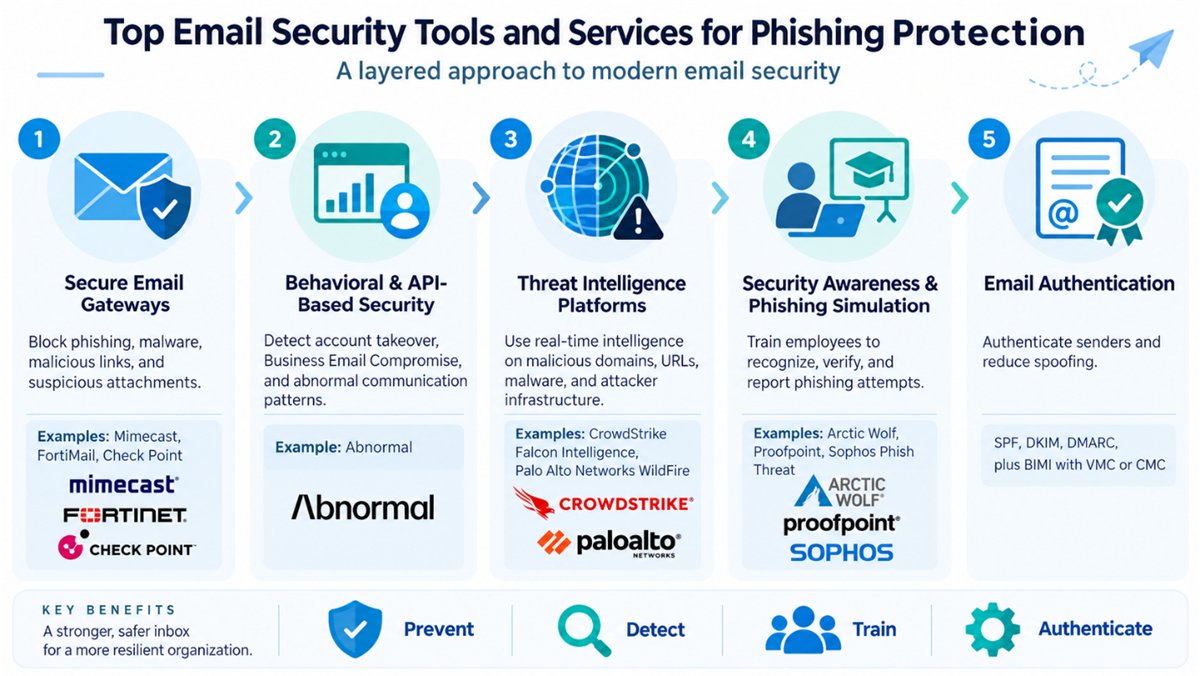
A modern strategy therefore combines multiple defenses, including:
- Secure Email Gateways;
- behavioral and API-based security;
- threat intelligence;
- phishing simulations and awareness training;
- sender-authentication protocols.
Together, these layers improve both prevention and response.
-
*
Secure Email Gateways and Email Security Platforms
A Secure Email Gateway (SEG) protects an organization's email environment against phishing, malware, malicious attachments, suspicious links, and other email-based threats.
Common capabilities include:
- content inspection;
- heuristic analysis;
- sandboxing;
- URL filtering;
- impersonation detection;
- threat intelligence;
- Transport Layer Security (TLS) encryption.
Modern email security platforms increasingly combine these capabilities with behavioral analysis and real-time threat intelligence.
Mimecast
Mimecast provides email security capabilities designed to detect phishing, malicious links, suspicious attachments, and impersonation attempts.
Key security capabilities include:
- sandboxing and click-time protection for suspicious URLs and attachments;
- protection against threats such as QR-code phishing and Business Email Compromise (BEC);
- integration with Microsoft 365, Google Workspace, and hybrid environments;
- integration with Security Information and Event Management (SIEM) and Extended Detection and Response (XDR) platforms to improve visibility and incident response.
Abnormal
Abnormal takes a behavior-focused approach to email security.
Rather than relying only on traditional signatures, the platform analyzes communication patterns, identity activity, and relationships between users and vendors.
Key security capabilities include:
- Application Programming Interface (API)-based integration with Microsoft 365 and Google Workspace;
- behavioral baselining of users and vendors;
- detection of unusual communication or login activity;
- automatic removal of malicious messages;
- investigation timelines across identities, applications, and devices.
This approach is particularly useful for attacks such as executive impersonation, vendor fraud, account takeover, and Business Email Compromise.
FortiMail
FortiMail combines multiple detection techniques to protect email environments from phishing, malware, impersonation, and account-based threats.
Key security capabilities include:
- anti-spam and anti-malware filtering;
- detection of emerging threat campaigns;
- impersonation and sender-analysis controls;
- sandboxing of suspicious attachments and links;
- heuristic and machine-learning-based analysis.
Check Point
Check Point's email security technologies combine message inspection with behavioral and language-based analysis to identify suspicious communications.
Key security capabilities include:
- visibility into inbound and outbound email activity;
- centralized visibility into quarantined messages;
- detection of account takeover activity;
- identification of suspicious behavior associated with compromised accounts;
- automated threat blocking and policy refinement.
Secure email platforms provide an important first layer of defense, but they become more effective when they can use broader information about malicious infrastructure and attacker behavior.
-
*
Threat Intelligence Platforms
A Threat Intelligence Platform (TIP) collects and organizes information about known and emerging cyber threats.
Threat intelligence can include:
- malicious domains;
- Internet Protocol (IP) addresses;
- suspicious URLs;
- malware indicators;
- attacker infrastructure;
- vulnerabilities;
- Indicators of Compromise (IOCs).
This information can be shared with email-security platforms, firewalls, SIEM systems, endpoint protection, and other security technologies.
For phishing protection, threat intelligence helps organizations identify malicious infrastructure earlier and understand the broader context surrounding suspicious activity.
CrowdStrike Falcon Adversary Intelligence
CrowdStrike provides threat intelligence designed to help security teams understand adversaries, infrastructure, vulnerabilities, and emerging campaigns.
Key capabilities include:
- malware and sandbox analysis;
- sharing of Indicators of Compromise;
- monitoring of attacker-controlled infrastructure;
- adversary and vulnerability intelligence;
- information that can support proactive investigation and response.
Palo Alto Networks WildFire
WildFire is Palo Alto Networks' cloud-based malware analysis and threat-prevention technology.
It analyzes suspicious files and content using multiple detection methods.
Key capabilities include:
- machine-learning-based threat analysis;
- dynamic and static file analysis;
- malware sample investigation;
- pattern recognition across large datasets;
- automated sharing of threat intelligence with connected security controls.
Threat intelligence improves technical detection, but technology alone cannot eliminate phishing risk. Employees still need to recognize suspicious communications and know how to respond.
-
*
Phishing Simulators and Security Awareness Tools
Phishing simulations give employees practical experience with realistic social-engineering scenarios.
Rather than relying only on theoretical training, organizations can send controlled simulated phishing messages and measure how employees respond.
These exercises help users learn to:
- identify suspicious messages;
- inspect links and sender information;
- avoid unsafe attachments;
- question unusual requests;
- report potential phishing through approved channels.
Simulation platforms also allow security teams to identify higher-risk groups and provide additional training where necessary.
Arctic Wolf Managed Security Awareness
Arctic Wolf provides security-awareness content designed to reinforce secure employee behavior through regular training.
The program uses short learning modules intended to make security education easier to integrate into normal working routines.
Proofpoint Security Awareness
Proofpoint provides role- and risk-based security-awareness training.
Organizations can tailor educational content according to employee responsibilities, observed behavior, and threat exposure.
The platform also supports simulated phishing campaigns, allowing organizations to test employees with realistic scenarios and provide targeted follow-up training.
Sophos Phish Threat
Sophos Phish Threat allows organizations to run simulated phishing campaigns based on realistic attack scenarios.
Organizations can use different campaign templates and difficulty levels to test employee awareness and reinforce safer behavior.
These simulations help turn employee training into a measurable part of the wider phishing-defense strategy.
-
*
Email Authentication Protocols
Detection and training become more effective when organizations also protect their own domains against impersonation.
Email-authentication protocols help receiving mail systems determine whether messages claiming to originate from a domain have been properly authenticated.
Sender Policy Framework
Sender Policy Framework (SPF) allows a domain owner to publish which mail servers are authorized to send email on behalf of the domain.
Receiving servers can check the sending server against this published information.
DomainKeys Identified Mail
DomainKeys Identified Mail (DKIM) adds a cryptographic signature to an email.
The receiving mail server verifies this signature using a public key published in the sender's Domain Name System (DNS) records.
This helps verify that the message was authorized by the signing domain and that signed portions of the email were not modified in transit.
Domain-based Message Authentication, Reporting, and Conformance
Domain-based Message Authentication, Reporting, and Conformance (DMARC) builds on SPF and DKIM.
DMARC checks whether authentication aligns with the domain visible to the recipient and allows domain owners to publish a policy describing how failed messages should be handled.
It also provides reporting that can help organizations identify unauthorized use of their domains.
-
*
Blueprint for Building a Modern Email Security Posture
The strongest email-security strategy combines multiple controls rather than relying on a single product.
- Strengthen the Email Perimeter
Start with an email-security platform capable of inspecting messages, links, attachments, sender behavior, and impersonation attempts.
Controls such as sandboxing, URL inspection, malware analysis, and behavioral filtering can stop many threats before users interact with them.
- Add Threat Intelligence
Connect email-security systems with current threat intelligence.
Threat intelligence provides context around malicious domains, URLs, infrastructure, malware, and attacker activity, helping security teams identify suspicious messages faster.
- Build Employee Awareness
Combine technical controls with regular, role-based security training and phishing simulations.
Use simulation results to identify higher-risk users or departments and provide targeted learning where necessary.
The goal is not simply to reduce clicks. Employees should become better at recognizing and reporting suspicious communications.
- Enforce Sender Authentication
Implement SPF, DKIM, and DMARC to strengthen domain authentication and reduce direct domain spoofing.
Organizations using Brand Indicators for Message Identification (BIMI) can add a Verified Mark Certificate (VMC) or Common Mark Certificate (CMC) where appropriate to support authenticated brand-logo display in compatible email clients.
These technologies complement email authentication and help legitimate brand communications stand out more clearly.
-
*
Multi-Layered Email Security Model
Security Layer Strategic Goal Examples Secure Email Gateways and Email Security Platforms Detect phishing, malware, malicious links, attachments, and impersonation Mimecast, FortiMail, Check Point Behavioral and API-Based Security Identify Business Email Compromise, account takeover, and unusual communication patterns Abnormal Threat Intelligence Platforms Add context about malicious domains, infrastructure, malware, and attacker activity CrowdStrike Falcon Intelligence, Palo Alto Networks WildFire Security Awareness and Phishing Simulation Train employees to recognize, verify, and report suspicious communications Arctic Wolf, Proofpoint, Sophos Phish Threat Email Authentication Authenticate domains and reduce spoofing SPF, DKIM, DMARC, with BIMI and Mark Certificates providing an additional visual trust layer -
*
Conclusion
Phishing has evolved beyond obvious spam and poorly written fraudulent messages.
Modern campaigns can imitate professional communication, trusted brands, vendors, colleagues, and executives. Artificial Intelligence makes personalization and message creation even easier for attackers.
That is why effective email security cannot depend on one technology.
Organizations need a layered security architecture combining email protection, behavioral analysis, threat intelligence, employee awareness, and sender authentication.
Each layer addresses a different part of the phishing problem. Together, they make it harder for malicious messages to reach users, harder for impersonation to succeed, and easier for organizations to detect and respond when an attack gets through.
-